/* BeejBlog */

Our 4-Hour Body Recipe

Link to Amazon

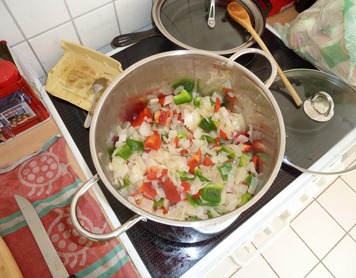
Ferris gets right to his go-to Mexican oriented mix pretty quick into the fat loss section of the book… it’s very quick reading to pick up his basic approach.   Here’s how we’ve taken that and made it our own:

  • Full Size White Onion chopped up (probably any kind of onion will do)
  • Full Size Tomato chopped up
  • Full Green or Red Bell Pepper chopped up
  • Can of Black Beans (pinto and kidney work as well of course… we just really like black beans)
  • Grilled Large Chicken Breast

Those items are all basically on a 1:1 ratio. *5* of each fills our 6 quart “stock pot”, which will last the two of us through a work week. Along with those primary stock items, we also flavor in some diced garlic… I love garlic, I go kind of nuts with it.

To spice it up, I do a full 16 oz. jar of Vlasic *hot* pepper rings (what I call pepperoncini's)  -AND- a full 12 oz. jar of sliced hot jalapenos… including the juice from both (keep an eye out for corn syrup here)… those give it a fun kick… which should also help manage appetite. I think you’d want the full 5x of everything else to take on those full jars of spiciness… please start out with less until you find your preferred balance.

To help freshen up each reheated serving, we melt in some grated cheese (keep it very minimal since this is on the avoid list), then toss on a dollop of sour cream and some avocado slices.

Tim gives pointers on what to avoid just as much as what to embrace… pretty much all fruit sugars are on the avoid list, no big surprise. Another is to avoid many things that are white due to flour or starch, which is also a fairly common thread of advice from other dietary sources.

It’s nice to load up the digital version of the book and hit the hyperlinks to the references… the weight tracking spreadsheet, etc.

Good luck with your goals and have fun! :)
HighPoint RocketRAID 620 indeed works for Hackintosh

Update [2011 Aug 6]: The original drivers appear to work just fine under Lion v10.7
Please see here for background on the “main PC = NAS” approach this hardware facilitates.
And here for my other Hackintosh tribulations with getting my old graphics card to work.
I’m very satisfied for a $60 part… the drivers loaded right up under both Win7 and OS X v10.6.6 (and 10.7 currently)
As a side note: This all works well in tandem with Parallels Desktop v6’s Boot Camp virtualization facility where I can dual boot into my one sole Windows 7 install *natively* or via a Parallels VM under OS X (I know VMware has something identical but from what I’ve read, Parallels still has the edge on performance).
The drivers on the install disc were up to date… and I’m taking it as a good sign that they haven’t found need to update them for over a year now.
Windows 7 Driver – currently: v1.1.9.1221, 12/21/2009
OS X Driver – currently: v1.1.0, 12/22/2009
There is the usual BIOS based boot time configuration screen you can pop into to manage your arrays.
And you can also install a management “Web GUI” … this is obviously driven by a mini web server that runs under your OS on a certain port… this is *NOT* plugging an ethernet cable into the RAID card itself… it is not that sophisticated… the whole thing is very bare bones, very old school but seems to have the basics covered (time will tell)… it’s loaded via an old Installshield style setup.exe that I recognize from the early 90’s … the web screens themselves are completely boring old school stuff which stands out in a bad way these days but truly, <ValleyGirlMode> whatevers </ValleyGirlMode>.
looking at the benchmark from CrystalDiskMark… those sequentials look respectable but I guess the other rates are pretty poor???
those specs are running the RocketRAID on these drives: Hitachi Deskstar HD32000 IDK /7K (2TB 7200 RPM 32MB Cache SATA 3.0Gb/s 3.5" Internal)
image       image
The card itself is very miniscule… about 2.75" inches square (see below)… it is a “1 lane” card (i.e. “X1” in the PCI-express common parlance)… but it is PCIe 2.0 so you absolutely want to put it in a 2.0 capable slot if you can and on my mobo that is a x16 lane slot… which “looks” like a waste but is totally fine for me because I’m not a gamer so I’m not using that secondary PCIe x16 slot for an SLI gfx card or anything useful anyway.
DSCF5030 - closeup
Checkout this last photo… I realized the RocketRAID card’s bracket alignment was off quite a bit (too short)… after installing, the card would slide itself loose of the slot… so much so that the mobo’s electric disconnect warning light for that slot came on… the bracket for my graphics card right next door doesn’t exhibit anything close to this height deficit so I’ve got to assume the RocketRAID is a bit out of spec… after scratching my head for a minute, the obvious solution that presented itself was to move the bracket *under* my case’s card stability rail... it seems like my Antec Skeleton’s card rail particularly lends itself to this approach… I wonder if a normal case’s bracket screw down area would ?
P1050814 - closeup

Reclaiming disk space from “system volume information”

This sums it up very well

Don’t forget to run the VSSAdmin commands under a 64bit CMD.exe if you’re on 64bit Windows.

I know that sounds obvious but I run something called TakeCommand Console LE which is a great shell but the free version is 32bit only.

Visual Studio 2010 Slow Startup [resolved]

Apparently the culprit of my slowdown was the VMware debugger integration… resolution here

I merely uninstalled the VMDebugger component via VMware Desktop setup.exe …  I did *not* have to completely uninstall all of VMware Desktop to see an significant improvement to Visual Studio startup time… down to a few seconds now from something that felt like 30 seconds.

Fix Orphaned SQL Server Database Users

Good reference

Quick examples:
sp_change_users_login 'report' -- this shows the list of orphaned users in the current database
sp_change_users_login 'update_one', 'iTRAAC_User', 'iTRAAC_User' -- this is how you remap one

Projector Roundup 2011 Q1

For my own comparison notes, I got an "Epson PowerLite Home Cinema 720" for $1000 back in May 2009 (according to ProjectorCentral.com it’s already discontinued, I’m not surprised, this is a rapidly evolving technology segment)… so our specs are: 720p, 1600 Lumens, 10,000 contrast, 3000 hour bulb, 2 yr warranty.

The Epson Home Cinema's seem to be hanging strong in the top 10 most popular slots over the last few years.

The Epson 8350 seems to be their latest best in the $1000 range ($1200 street 14 Feb 2011)

1080p, 2000 lumens, 50,000 contrast, 4000 hr bulb, 2 yr warranty.

Reviewers seem to indicate the Epson 8700 UB ("ultra black") is well worth the extra bux ($2100 current street)

1080p, 1600 Lumens (1800+ according to review), 200,000 contrast, 4000 hr bulb, 2yr warranty.

The comparison to long standing champ "Panasonic PT-AE4000U" at the end of this review is interesting:

One thing to really look for is the *free bulb* (~$300 value) & other mail in rebate specials that vendors use to drive attention for higher end models, especially for the first year or so.

I was kicking myself because I had just missed the window of opportunity for these rebates on mine by the time I was ready to buy.

I feel like a free bulb takes a lot of the worry out of these suckers... they say about 3yrs a bulb for average use...

3 yrs is just long enough that you're going to loathe buying a new bulb vs a whole new projector technology.

6 yrs is great peace of mind.

The 8700UB just came out in Oct.2010 and apparently the free bulb offer goes to March *2012*

and there's also a $100 mail in rebate that goes through March *2011*

CTRL, 1 – Mutes Windows Sound?!?!

Is this a standard???  I can’t find reference to this hot key sequence out there in Google land.

You need to hit CTRL, release and then hit 1, not CTRL-1, i.e don’t hold down CTRL.

On my (*non* Windows Media Keys Keyboard under Windows 7) system here, it works with both left and right CTRL and main keyboard or numeric keyboard “1”.


Google Keywords: Windows 7, Audio, Mute, Volume, Control, CTRL, 1, One